Electricity storage will span many scales as we electrify end-use and decarbonize supply. Batteries might be on garage walls (PowerWalls and similar), on wheels (EVs), on poles (next to transformers), on pads (by the local school or small business), in parking lots (to plug into the solar panels on your big box store’s roof), in substations, or upstream of it all, in a field somewhere near wind or solar farms.
It’s clear “all-of-the-above” is the answer; the questions are rather “how much of each” and “which should we accelerate via policy?”. The way people typically answer this is with cost-benefit modelling, where costs are determined by capacity expansion models and benefits are calculated from reduced emissions, reduced energy expenses, investor returns, etc. This post is not a summary of this type of extensive analysis. Instead, I want to tease out what the archetypes of storage are, so we can discuss which we want more of 1 These are some dangerous words, I know. But distribution grids are so ill-known NREL uses building age as a proxy for transformer age, so it’s unlikely that we know their condition well enough to make claims about upgrades, replacement costs, etc… And yet we must build all these end-use machines on a shorter timeframe than regulators will be able to agree on how to measure and report on millions of transformers across thousands of utilities. .
The wires define storage activity “archetypes”
Saul Griffith has an amazing graphic on how the wires contribute to electricity costs 2 Rate structures aren’t the same across industrial, commercial, and residential customers. That matters to this discussion. in his latest book, Plug in!:
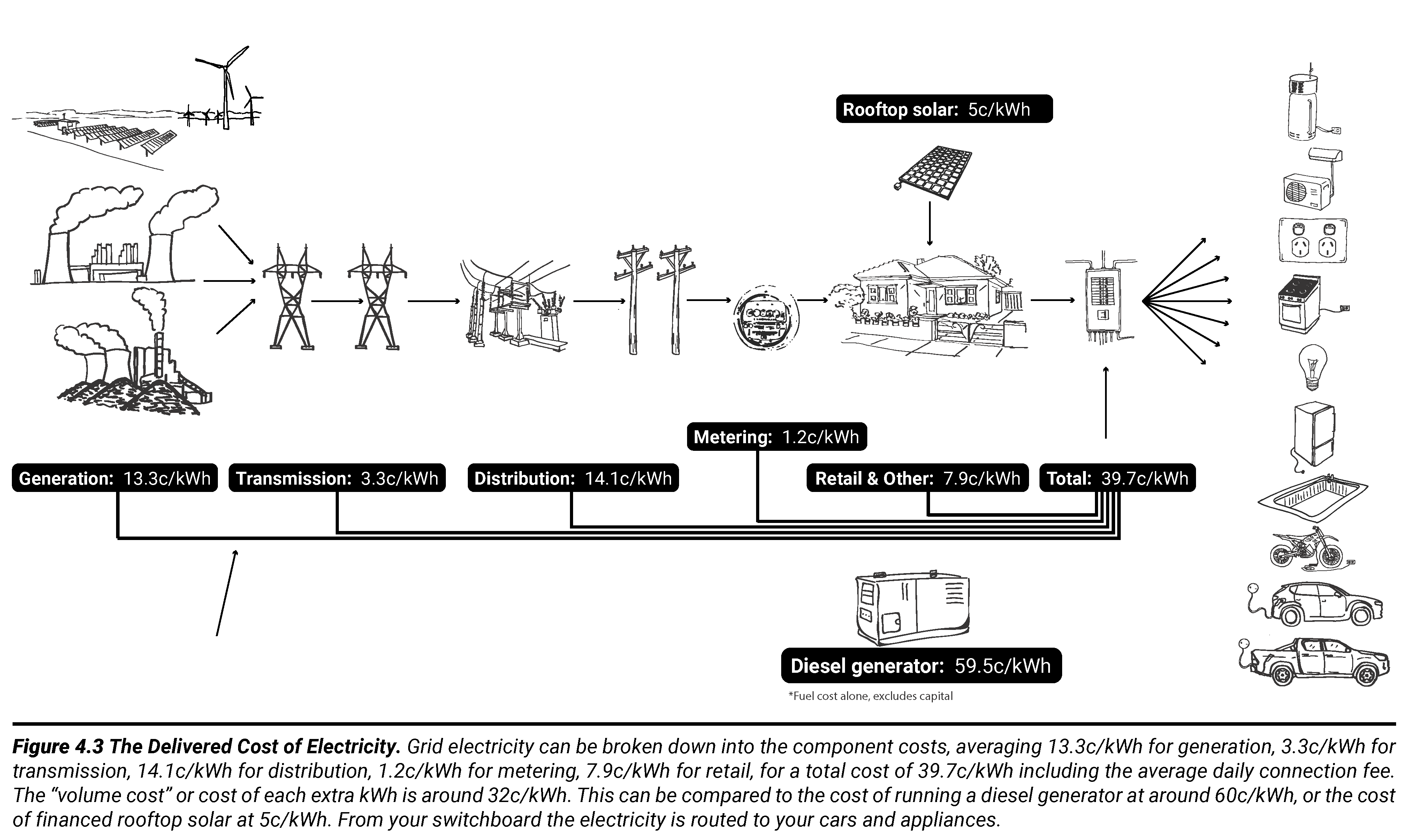
We see that a big driver of electricity costs is its transport by wires from far afield. It’s useful, then, to consider types of storage dispatch based on their relationship to the wires (with examples):
- storage to load (your car to your house)
- storage to distribution poles (your neighborhood battery to the poles and wires nearby)
- storage to the bulk system (a big battery in a field feeding the medium-high voltage power lines running to town)
As well as three types of storage charging:
- supply to storage (panels on your roof to your garage battery)
- distribution to storage (solar soaking into a local battery via the grid)
- bulk system to storage (a big battery in a field absorbing wind from another field)
The key for costs is that these types are hierarchical. Power dispatched on the bulk transmission system passes through the distribution network and your meter to heat your kettle. Power dispatched from within your distribution feeder can make it to your kettle while remaining below the substation, using only distribution wires and pole-mounted transformers. Power dispatched to your electrical panel has a shorter route to being useful.
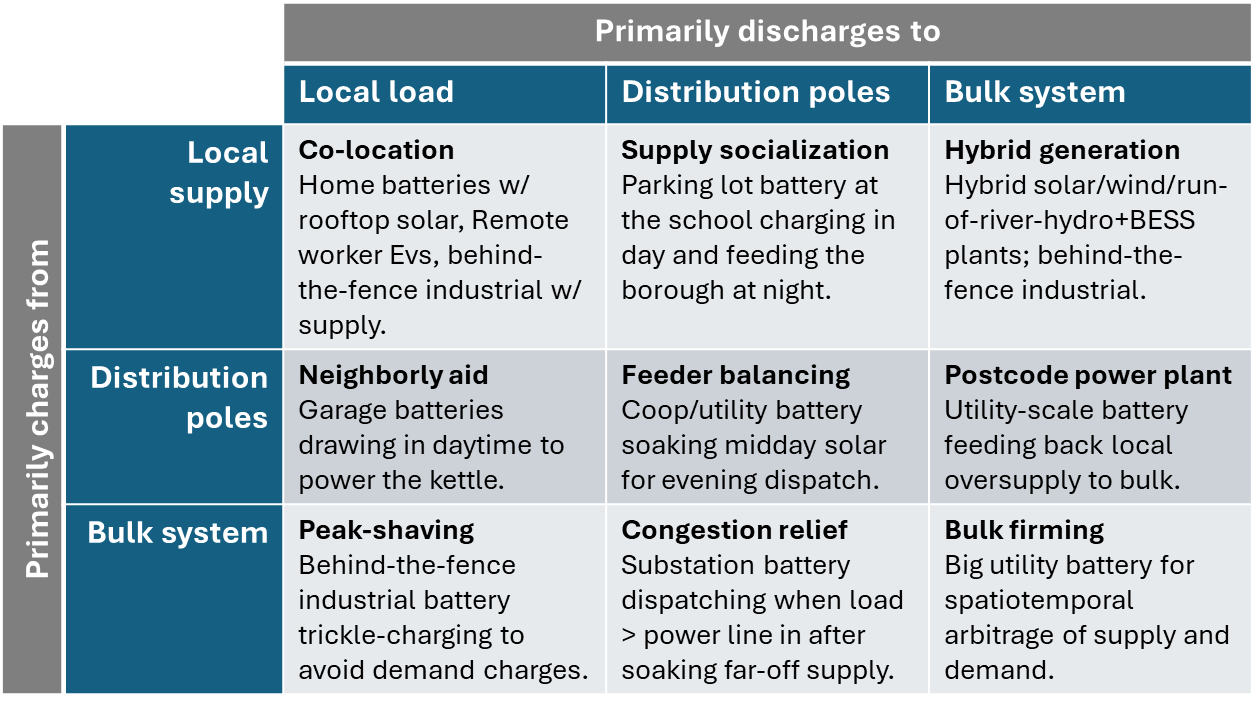
If we look at combinations of charging and discharging, we get the table below. I named and gave exmaples of archetypal use cases. Some exist today, like co-location or bulk firming, while some are instead possible, like supply socialization.
Which do you think will win, and why?